TRENDING Texans cruise on TNF Ravens send Humphrey home 'GTA 6' impacts sports New Jersey Little Leaguer dies Kiffin's return to Tennessee Story by Jori Epstein Senior reporter Fri, November 20, 2026 at 5:04 AM UTC · 9 min read About Our Ads Advertisement Advertisement Advertisement Entering Week 11 of the 2026 NFL season, clubs find themselves asking what's become a familiar question: Will this season's NFL playoff bracket actually feature the NFL's best teams?
The NFC South is trending dangerously close to fronting a sub-.500 division winner for the second consecutive year and third time in five years (the 4-5 Carolina Panthers currently lead the division). Across the conference, three NFC West and all four NFC North teams each stand above .500. If the playoffs started this week (they don't), the 6-4 Seahawks and Rams would each miss out.
The discrepancy leaves some in the league questioning the eight-division playoff structure that has stayed relatively consistent since 2002. For the first 20 years of that reign, only three teams won a division without winning at least half of their games (two more finished 8-8). Since the league expanded its regular-season schedule to 17 games in 2021, the frequency of sub-.500 teams hosting wild-card games has ticked up.
"What makes the disparity worse in the last five years for sure is that we've added another [regular-season] game," one source with knowledge of league playoff proposal debates told Yahoo Sports. "The more you add games, the more separation in the standings you get."
And with the league's determination to add an 18th regular-season game by the next collective bargaining agreement (the NFLPA would have to agree to any schedule expansion), the disparity could only worsen.
What will factor into league decisions on whether to amend the playoff structure in the coming years, or in concert with the addition of a possible 18th game? Yahoo Sports surveyed high-ranking league sources to better understand the debates from recent annual meetings as well as the most likely factors to motivate any changes.
Sources were split on whether they wanted any shift to the structure — and how that shift should materialize if it does unfold.
One high-ranking NFC executive who favors revamping the playoff structure was skeptical anything will change in the next five to 10 years, even if the schedule expands to 18 games.
"I think it'll take an egregious deal," the executive told Yahoo Sports. "It'll take freaking someone winning the NFC South with seven wins and somebody coming in with like 12 wins. It'll take something like that, and it'd probably take an influential owner to be on that 12-win team."
Would the NFL ever consider eliminating divisional favoritism altogether in favor of seeding a conference purely by record?
Those in favor of maintaining the playoff-structure status quo cite the value of divisional excellence.
From a practical standpoint, 14 of a team's 17 regular-season matchups are identical to those of their division foes. Every team plays six in-division games, four teams from another division in their conference and four teams from a division outside of their conference. The remaining three opponents reflect a team's record the prior year. That means ranking teams within a division eliminates most of the strength-of-schedule variance that exists between divisions.
"Strength of schedule is usually the most accurate predictor of teams who are good or bad," a second high-ranking NFC executive told Yahoo Sports. "At the end of the year when you look at who the surprise teams are, and you look at their strength of schedule, I promise you their strength of schedule is weak."
Added a high-ranking AFC executive: "It gives every group of four the same opportunity."
On a more emotional note, rewarding divisional wins with a top-four seed and a home playoff game puts a premium on the value of winning intradivisional games. Rivalries rage more strongly as the stakes rise. The geographic proximity between many division rivals contributes to the heightened tenor.
"It's good for fandom, it's good for the game, it's good for television," the first NFC executive said.
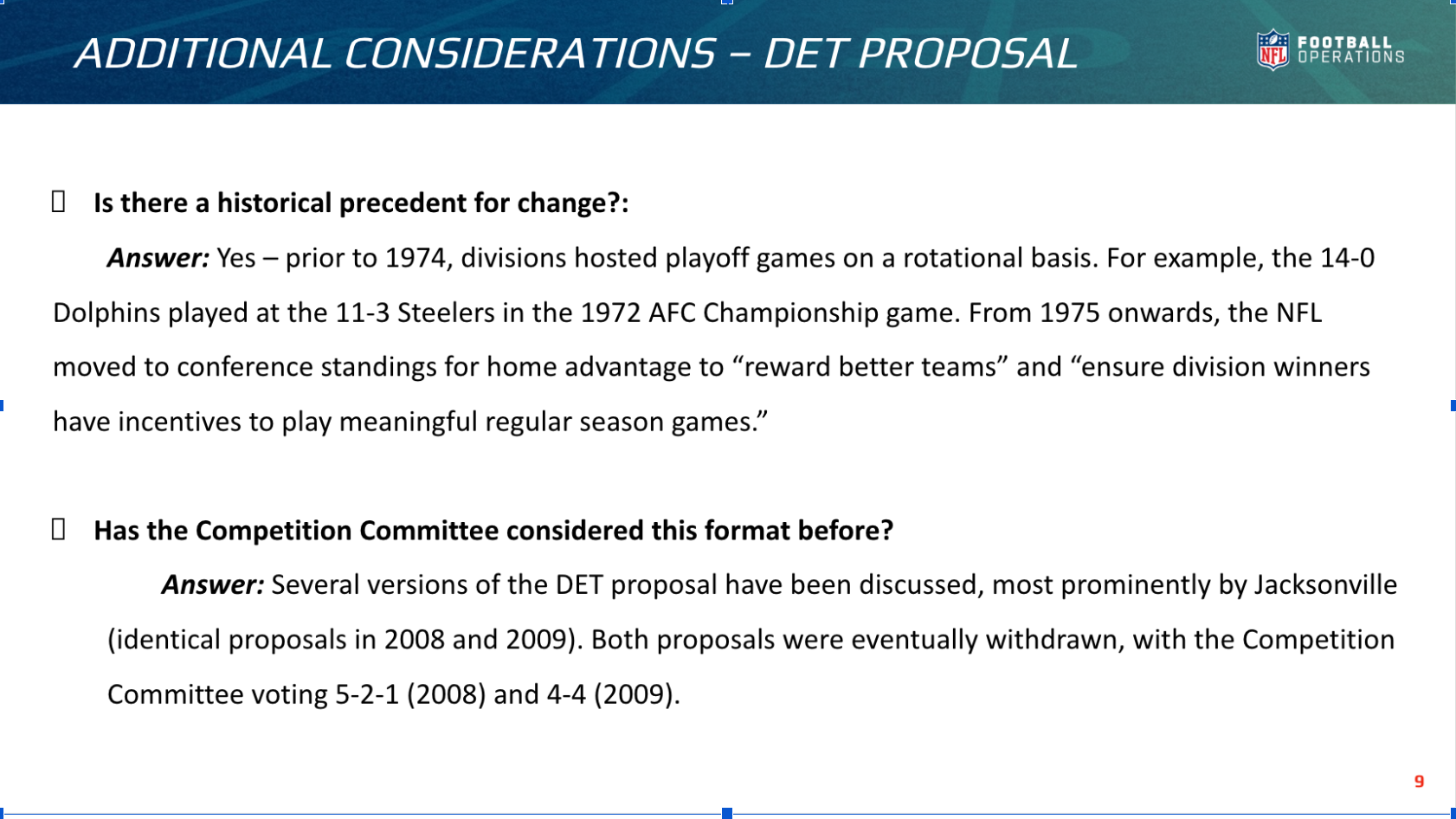
Each of these concerns has reached the NFL annual meetings, from 2008 and 2009 proposals withdrawn after split votes from the competition committee to more recent proposals at the 2023 and 2025 NFL annual meetings.
In 2023, the Chargers proposed seeding wild-card teams higher than division champions when the division champion 1) finishes below .500 and 2) has lost four or more games than a wild-card team.
In 2025, the Lions proposed more broadly to seed wild-card teams higher than division champions when wild-card teams finish with better records.
Excerpt from a presentation at 2025 NFL owners meeting debating the Detroit Lions' playoff proposal.
Neither proposal dared to suggest a division winner shouldn't clinch a playoff spot. But each questioned whether struggling division winners deserved to automatically host a playoff game.
The proposals failed to generate sufficient support to pass.
Sources in favor and opposed to shifting the reward toward record alone admitted: Playoff formulas that dive into the minutiae of counting win discrepancy between division winners and wild-card advancers could complicate and decrease fan interest in predicting playoff brackets. Determining the exact threshold of a change is controversial, too. Multiple sources surveyed for this story mentioned how Tom Brady and the New England Patriots' success was undoubtedly helped by playing in an otherwise-weak AFC East during his tenure. But no team influences the strength of its own division, nor the divisions it's selected to play that year.
"More often than not, it's not a direct correlation that, 'Oh, you got 12 wins, you're better than the 10-win team …'" the first high-ranking NFC executive said. "It gets dicey to try and figure out something that's ' fair' for everybody and passes the smell test, because there are some divisions that the teams are better, and I can acknowledge that."
Clubs admitted during the 2025 meeting discussions that the current playoff formula has limitations, a source present for those discussions told Yahoo Sports. But teams overwhelmingly felt the current playoff structure fit the current schedule format better than the alternative.
A high-ranking AFC executive who believes in the current playoff format questioned the itch for change.
"There's too many people in our league that want to change rules every year and change formats," the executive said. "We have a divisional structure and that is the first benchmark. … I think the history of it is the way it should be."
In the 2024 NFL season, Jared Goff and the Lions won a high stakes NFC North battle against the Vikings that decided the division on the final day of the regular season. (Photo by Steven King/Icon Sportswire via Getty Images)
When the league debated Detroit's proposal last year, a presentation weighing the merits touted four main benefits, per a copy obtained by Yahoo Sports:
The end of the regular season would be more competitive.
The end of the regular season could draw more fan interests, better ticket value and better TV ratings.
The chance of a conference's two best teams playing in the conference championship (rather than a wild-card or divisional-round game) would increase.
The main drawback cited: decreasing the incentive to win a division.
The emphasis on late regular-season competition reflected what could be a key force in any eventual postseason shift. As the regular season has grown already to 17 games, with discussions of 18 on the horizon, the chance to secure playoff spots with multiple weeks left to play grows. The league's current requirement that all regular-season finales feature divisional games already guarantees a handful of lopsided divisions in which at least one team has nothing to gain by winning. Sometimes, a game features a division winner with no playoff movement possible and a desire that a divisional opponent wins to hurt the opponent's draft stock. Starters increasingly rest during regular-season finales.
"When you add an 18th game, there's a lot of consequences …" the league source who was present for the playoff proposal discussions said. "[As] teams get further apart in the standings and in terms of draft order and playoff seeding, it leads to a last week of the season that may also require other changes in terms of incentives for playoff qualification or the draft."
These conversations could go hand-in-hand with determining the formula for a potential 18th game. Consider that at that schedule size, divisional games would account for just one-third of a team's schedule. With 12 non-divisional opponents to play, each team could in theory play all three other divisions in its conference if the league sought to level the strength-of-schedule playing field within the NFC and AFC brackets.
"Now, that goes against the NFL's whole notion of trying to create parity," a high-ranking NFC executive said. "The NFL wants bad teams to play a bad team so someone gets a win so that every year they can say four or five new teams make the playoffs. I think that is really valuable."
The league already expanded the playoff bracket from its 30-year run of 12 teams to 14 in 2020.
For now, the league will turn its eye toward the cellar-dwelling NFC South and the not-far-ahead NFC East to see how poorly the worst playoff participants will finish this season.
After that? Expect conversations to continue to simmer, while also expecting momentum for change to remain slow in a league that values tradition and divisional competition.
"I don't think you can change anything until you have a more balanced schedule," the high-ranking NFC executive reiterated. "Winning your division means that the teams that played the closest facsimile of the schedule of yours, you are better than. That deserves a home game.
"Nobody's sitting here talking about the Giants having played [among] the weakest strength of schedule and having a winning record and getting a home game. So to me, until teams all play a balanced and fair schedule, the playoff format is really a waste of time from a discussion standpoint."
Source: Sports
