Rescuers nursed a green sea turtle back to health and watched it swim almost 2,000 miles with a satellite tagAdrian Villellas Sun, November 8, 2026 at 5:37 AM UTC
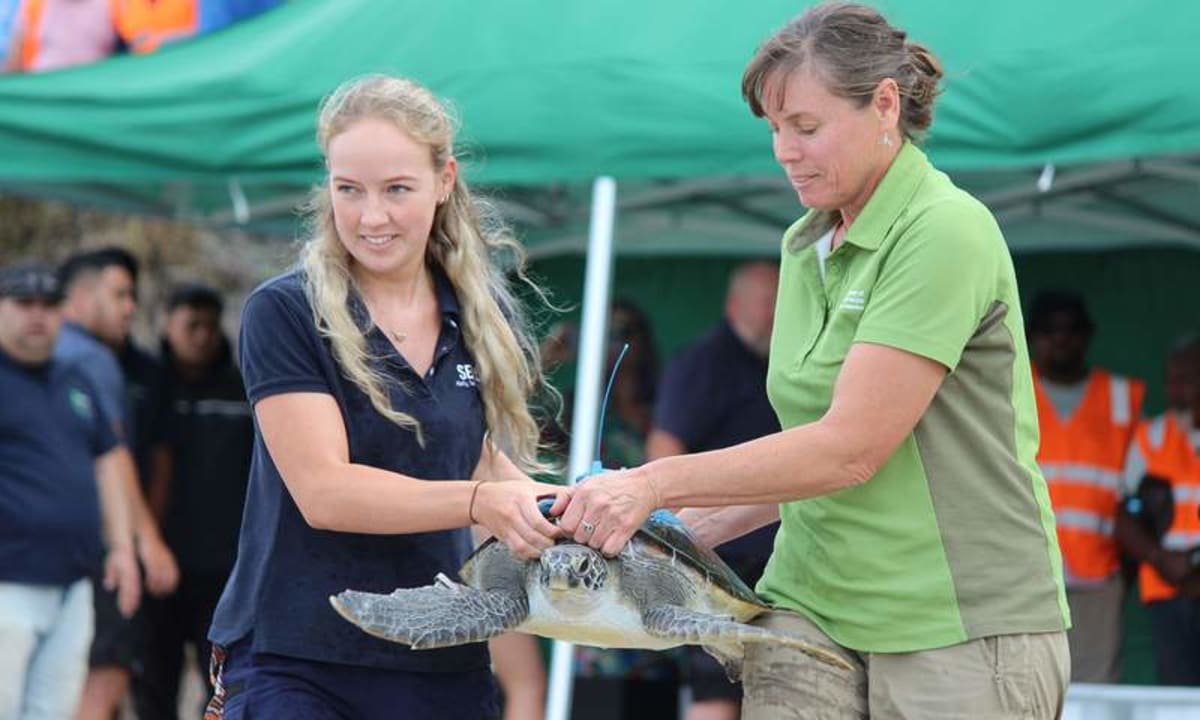
A satellite-tagged green sea turtle is carried to shore for release in Northland, New Zealand. Credit: Department of Conservation (DOC)
On the afternoon of March 12, 2025, five rehabilitated green sea turtles were let go in Rangaunu Harbour, in the far north of New Zealand. Two of the five had satellite tags on their shells.
By now 11 turtles have been tagged. One of them, nicknamed 3K, clocked up nearly 1,860 miles (3,000 kilometers) in four months.
It went from Rangaunu down the west coast to Wellington and back, the Department of Conservation (DOC) reported on October 29.
DOC put out the update together with Auckland Zoo and SEA LIFE Kelly Tarlton’s Aquarium in Auckland. No journal paper sits behind it. These are tracking results from 11 animals so far, and every one of them was a patient first.
Eleven tags, 25 satellites
Team Turtle is the name of the project. DOC leads it with Auckland Zoo and SEA LIFE Kelly Tarlton’s. Iwi, the Māori tribes of the area, work alongside them.
Since 2025, each of the 11 has been tracked daily for six to 12 months. The location data go through Kinéis, a new network of 25 satellites, which DOC says gives highly accurate positions. The transmitters were meant to last up to a year.
Back in 2025, DOC said this was the largest satellite tagging study ever undertaken for green turtles in New Zealand. The plan was to tag up to 20 turtles over three years.
That same year Andrew Christie, curatorial manager at Kelly Tarlton’s, said the aquarium had rehabilitated more turtles than ever before.
Five species of turtle are seen in New Zealand waters, and green and leatherback turtles are the most common. Dr. Karen Middlemiss leads the project as a marine senior science advisor at DOC.
Green turtles don’t breed in New Zealand, she said, yet juveniles and sub-adults show up regularly in the warmer North Island waters. She compared the country to “a baby-sitting service for teenagers” before they head back to Pacific nesting beaches.
3K’s run to Wellington
3K left Rangaunu Harbour and followed the west coast south until it reached Wellington, at the foot of the North Island.
On the way home it spent a month in Manukau Harbour, on the Auckland side. The round trip added up to nearly 1,860 miles (3,000 kilometers) in four months.
A second turtle, released at Taupō Bay in Northland, took the other side. It went down the east coast as far as the Coromandel, turned around, and settled in Rangaunu Harbour.
Tracking data of a green sea turtle over six months off Northland, New Zealand. Credit: Department of Conservation (DOC); base imagery Google. Click image to enlarge.
Before the tags, the team knew very little about individual turtles, Middlemiss said. Nobody knew if individuals stayed in one place for long periods or kept moving to other parts of the country. In the Galápagos, tags showed some green turtles remain homebodies for months.
Nesting females tagged on Diego Garcia, in the Indian Ocean, do not always swim straight to their feeding grounds.
Seagrass in Rangaunu Harbour
DOC picked out several places from the tracks for future work. In Northland these are Rangaunu Bay and Harbour, Pārengarenga Harbour, Murimotu, Whangārei Harbour and the Bay of Islands. Manukau Harbour in Auckland is on the list too.
Turtles that spent most of their time in Rangaunu Harbour were most often located over seagrass and harbour channels. Green turtles eat mostly seaweed, seagrasses and algae, according to NOAA Fisheries. Some have gone back to the same seagrass meadows for about 3,000 years.
Two iwi, Ngāti Kahu and Ngāi Takoto, whakapapa (trace their ancestry) to Rangaunu. Wiremu Marsden, Ngāi Takoto Taiao Team Lead, said in 2025 that honu, the Māori word for sea turtles, have always been in the harbour.
Nina Raharuhi is hapū (subtribe) cultural monitor for Ngāti Kahu, with Ngāti Whātua affiliation. In 2025 she said the honu come in from the subtropical islands for a rest, shelter and food before they go off to breed.
The strandings of the previous two years worried her. She wondered if water temperature, lack of food, what was in their food or microplastics were to blame.
This October she said the release of the 11 honu “represents hope, healing, and our shared responsibility as kaitiaki,” or guardians. Her message to boaters and fishers on the harbour: “Ata haere, kia tūpato,” which she translated as take it easy and be careful.
Fishhooks, boat strikes, pneumonia
Dr. James Chatterton is the veterinary services manager at Auckland Zoo. August to December is the busy stretch for sick turtles at the zoo, he said, and eight had come in since June.
The cases he listed were fishhooks, line entanglement and boat strikes. Pneumonia and intestinal infections turn up too, usually after the turtle’s immune system has been knocked down. His guess is that less food, a damaged marine environment, or both, are behind that.
“The good news is more than two-thirds of the green sea turtles we admit go on to make a full recovery,” Chatterton said. He wants the sea itself to improve so that more of them do well once they are back in it.
SEA LIFE Kelly Tarlton’s general manager, Dan Henderson, said the results show how linked New Zealand’s marine habitats are. His aquarium plans to use them to show visitors what ocean animals face.
DOC gave boaters four tips: slow down and keep the boat off the plane where turtles live, wear polarized sunglasses, name a spotter, and fit a propeller guard.
An injured or stranded turtle should be reported to 0800 DOCHOT, DOC’s hotline. People should not handle it unless DOC staff say so, and all sea turtles in New Zealand waters are threatened.
Nine more turtles to tag
Eleven turtles have been followed, six to 12 months each, and every one was a rescue animal. In March 2025 DOC noted that young turtles are hard on tags in coastal waters and can knock them off early.
The maps give positions and dates. They give no reason for 3K’s trip to Wellington, and none for the Taupō Bay turtle settling in Rangaunu. Chatterton’s idea about food and immunity is a suspicion at the zoo, not a result of the tracking.
To reach 20 turtles, Team Turtle will tag nine more, working with iwi and hapū. Middlemiss said regional councils are next on the list, to talk about getting turtles into coastal management plans.
In Western Australia, satellite tags helped scientists map where green turtles feed and migrate. The next turtles to leave rehab with a tag will be followed the way 3K was, to Wellington and back.
The information was obtained from the Department of Conservation.
—–
Like what you read? Subscribe to our newsletter for engaging articles, exclusive content, and the latest updates.
Check us out on EarthSnap, a free app brought to you by Eric Ralls and Earth.com.
—–
Source: Nature
