Trump keeps telling America he's winning in Iran. He's less clear in explaining how the war ends

WASHINGTON (AP) — Facingjittery global marketsanddrooping poll numberssince launchinga war on Iran, PresidentDonald Trumphas cycled from calls for"unconditional surrender"to sounding amenable to an end state in which Iran trades onehard-line ayatollahforanother.

Associated Press President Donald Trump speaks at the Republican Members Issues Conference, Monday, March 9, 2026, at Trump National Doral Miami in Doral, Fla. (AP Photo/Mark Schiefelbein) Defense Secretary Pete Hegseth listens as President Donald Trump speaks to reporters while traveling aboard Air Force One en route from Dover Air Force Base, Del., to Miami, Saturday, March 7, 2026. (AP Photo/Mark Schiefelbein) Mark Kelly, D-Ariz., leaves after a closed door briefing on the Iran war before the Senate Armed Services Committee at the Capitol Tuesday, March 10, 2026, in Washington. (AP Photo/Jose Luis Magana) White House press secretary Karoline Leavitt speaks with reporters in the James Brady Press Briefing Room at the White House, Tuesday, March 10, 2026, in Washington. (AP Photo/Julia Demaree Nikhinson)

APTOPIX Trump

Shifting comments from the Republican president and his top aides are adding to the precariousness of the 12-day-old conflict, which isimpacting nearly every corner of the Middle Eastand causing economic tremors around the globe. With neither side budging, the war is now on an unpredictable path — one in which a credible endgame is still unclear.

Defense Secretary Pete Hegseth on Tuesday told reporters it's up to Trump "whether it's the beginning, the middle or the end" of the war. Trump, during the course of one speech at a House Republican gathering on Monday, went from calling the war a "short-term excursion" that could end soon to proclaiming "we haven't won enough."

The vacillation has fueled criticism from those who say Trump lacks a clear goal. "They didn't have a plan," Sen. Mark Kelly, D-Ariz., told reporters. "They have no timeline. And because of that, they have no exit strategy."

A constantly shifting goal line

Since ordering the Iran bombardment, Trump has continually shifted his timelines and goals for his war against Iran, a crosscurrent of rhetoric that has delivered more questions than answers.

Over the last few days, Trump has called for the "unconditional surrender" of Iran's leaders, while suggesting he's already succeeded in achieving his objective of decimating Iran's military.

At the same time, Trump's team has sought to soothe anxious Americans that this won't be a long, drawn-out conflict, even as the president has insisted he hasn't ruled out the option of putting U.S. boots on the ground.

The U.S. military says that it has effectively destroyed the Iranian navy and made huge strides in defanging Iran's ability to launch missiles and drones at its neighbors throughout the region. And yet,the critical Strait of Hormuz, through which roughly 20% of the world's oil passes on a typical day, remains effectively closed to business, and Iranian leaders remain unbowed.

The Revolutionary Guard vowed Iran would not allow "a single liter of oil" through the vital waterway until the United States stops its bombing campaign. AndAli Larijani, Iran's top national security official, offered a menacing message on Tuesday after Trump had threatened to attack Iran "TWENTY TIMES HARDER" if Tehran stopped oil flowing through the strait.

"The sacrificial nation of Iran doesn't fear your empty threats," Larijani wrote on X. "Even those bigger than you couldn't eliminate Iran. Be careful not to get eliminated yourself."

Making the case to Americans

Trump has struggled to make his case to Americans about why preemptive action against Iran was necessary and how it squares with his pledge to keep America out of the "forever wars" of the last two decades that he's bemoaned for costing too much money and too many American lives. Thus far, eight U.S. troops have been killed andabout 140 injured in the retaliatory salvosfrom Iran throughout the region.

One of several reasons Trump has offered to justify launching the war is that he hada "feeling" that Iran was getting set to attackthe United States.

White House press secretary Karoline Leavitt slightly amended that position, telling reporters that the president "had a feeling" that was "based on fact."

However, Pentagon officials in private briefings have told congressional staffers thatthe U.S. does not have intelligenceindicating that Iran was planning to preemptively attack the U.S.

Recent polling showsTrump's decision to attack Iran hasn't come with the rallying-around-the-flag effect that has typically accompanied the start of recent U.S. wars.

About half of voters in Quinnipiac and Fox News polls said the U.S. military action in Iran makes the U.S. "less safe," while only about 3 in 10 in each poll said it made the country safer. A CNN poll found about half of U.S. adults thought the military action would make Iran "more of a threat" to the U.S., while only about 3 in 10 thought it would lessen the danger.

In that CNN poll, about 6 in 10 U.S. adults said they trusted Trump "not much" or "not at all" to make the right decisions about the U.S. use of force in Iran.

Advertisement

European allies are treading carefully after British Prime MinisterKeir Starmerand Spain's Prime Minister Pedro Sánchezfaced the wrath of Trump, who deemed themnot sufficiently supportivein backing his war of choice.

But even German ChancellorFriedrich Merz, who has been broadly supportive of the U.S.-Israeli campaign against Iran, said on Tuesday that "more questions arise with every day of war."

"Above all, we're concerned that there is apparently no joint plan for how this war can be brought quickly to a convincing end," Merz said.

Merz stressed that "Germany and Europe have no interest in an endless war" or in Iran's territorial integrity disintegrating.

Deflecting responsibility for school bombing

The president has chosen to deflect responsibility for the bombing of a girls' school in southern Iran on the first day of the conflict, a strike that killed at least 165 people.

Trump on Saturday blamed the attack on Iran, saying its security forces are "very inaccurate" with munitions.

On Monday, after the investigative group Bellingcat postedverified videothat showed a U.S. Tomahawk cruise missile hitting a Revolutionary Guard facility near the school, causing the explosion, Trump again insisted it could have been Iran's fault but said that he would accept whatever an ongoing U.S. investigation into the matter might find.

The presidenterroneously claimedthat Tehran had access to Tomahawks, a U.S.-manufactured weapon system that is only available to the U.S. and a few close allies.

Asked by a reporter, Leavitt didn't directly answer why Trump falsely asserted that Iran has access to the U.S.-made missile.

Instead, she responded in part that "the president has a right to share his opinions with the American public" while noting "he has said he'll accept the conclusion of that investigation."

Senate Minority Leader Chuck Schumer, D-N.Y., told reporters that Trump's claim "is beyond asinine."

"Again, he says whatever pops into his head no matter what the truth is," Schumer said. "And we all know he lies, but on something as formidable as this, it's appalling."

Sen. Kevin Cramer, a North Dakota Republican, was among Trump allies gently making the case that it was important for the Trump administration to clarify what happened to the school.

Cramer said the military must "do everything you can to eliminate those mistakes going forward."

"But you also can't undo it," he added.

Associated Press writers Joey Cappelletti, Ben Finley and Linley Sanders in Washington and Geir Moulson in Berlin contributed reporting.

Trump keeps telling America he's winning in Iran. He's less clear in explaining how the war ends

WASHINGTON (AP) — Facingjittery global marketsanddrooping poll numberssince launchinga war on Iran, PresidentDonald Trump...
Kilauea volcano erupts, closes Hawaii highways

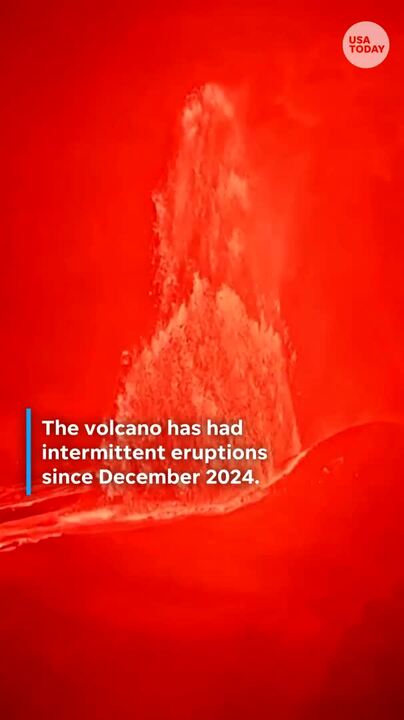
Hawaii Island'sKilaueavolcanobegan erupting on March 10,spewing rock fragmentsas large as footballs, threatening nearby communities and closing nearby highways.

USA TODAY

"Vigorous fountaining has started," Hawaii Volcanoes National Park said on itsFacebookpage.

The United States Geological Survey said fallout had created hazardous conditions in downwind areas, with one residentreportingmore than an inch of tephra — a mix of magma, rock and volcanic glass — on the roads of a golf course subdivision.

According to the United States Geological Survey, the eruption began at 9:17 a.m. Hawaii time, with a plume eventually reaching as high as 25,000 feet above sea level.

USGS videofrom the location featured dramatic footage of orange lava spewing from the volcano's Halemaʻumaʻu crater with plumes of black smoke floating skyward.

Park officials said Kilauea summit was closed due to "significant tephra fall," while falling tephra also forced the closure of a 16-mile stretch of nearby Highway 11.

Advertisement

"Avoid the area," officials warned on the park'sFacebook page.

TheUSGS observatorysaid large debris was raining on nearby communities.

"Golf course housing and highway 11 are being hit with tephra up to 5 inches," observatory monitors wrote.

Kilauea Volcano

Kilauea is among the world's most active volcanoes, with sporadic flare-ups since December 2024. This most recent eruption is the 43rd since Dec. 23, 2024.

Eruptions in late 2025 featured spewing lava lasting as long as five hours, fountains as high as 1,100 feet – and in November, a wind vortex of spinning ash known as a "volnado" within its caldera.

Reporter Kathleen Wong contributed to this report.

This article originally appeared on USA TODAY:Kilauea volcano erupts in Hawaii

Kilauea volcano erupts, closes Hawaii highways

Hawaii Island'sKilaueavolcanobegan erupting on March 10,spewing rock fragmentsas large as footballs, threatening near...
Nina Dobrev in Miu Miu Micro Miniskirt Proves She Is Truly an It Girl

If there's one thing Paris Fashion Week does best, it's turning the streets into a runway for statement style. This time,Nina Dobrevproved the same as she stepped out, serving effortless cool-girl energy in a striking Miu Miu micro miniskirt look that instantly caught every fashion watcher's attention.

The "Vampire Diaries" actress turned heads in a chic ensemble that balanced minimalism with a confident edge. With its sleek tailoring and playful styling, the look captured the Gen-Z-approved aesthetic the brand is known for. With this look, the diva showed us how to make a simple silhouette feel runway-ready.

Nina Dobrev brings cool girl energy to PFW in Miu Miu micro miniskirt

Instead of keeping things formal, Nina Dobrev dared to serve street-style sass at its best for her star-studded outing during the Paris Fashion Week 2026. She leaned into the playful preppy aesthetic that Miu Miu has recently made its signature. Her look featured a dark brown micro miniskirt with the brand's logo near the hem. This helped her flaunt her legs and elongate them. This was styled with a burgundy knit top, which worked wonders for her frame.

Advertisement

This was layered over a crisp white collared shirt that peeked through at the neckline and waist, adding a Gen-Z-approved school-girl touch to the look. Further, she added a sporty touch with a cropped brown zip-up jacket, accented with beige trim, giving the outfit an unexpectedly polished feel. Further, Dobrev completed the ensemble with tan mid-calf boots, which complemented the overall aesthetic of the look.

Dobrev's accessory game was also just right. She added a structured caramel-brown leather handbag that complemented the tones of her outfit. She also added minimal accessories, holding a pair of sunglasses. Meanwhile, her locks were styled in a slightly messy updo, adding to the effortless sass of her look. Even her flawless makeup, with blushed cheeks and nude lips, added some panache, making this look a standout moment at Paris Fashion Week.

Originally reported by Mehak Walia onTheFashionSpot.com.

The postNina Dobrev in Miu Miu Micro Miniskirt Proves She Is Truly an It Girlappeared first onReality Tea.

Nina Dobrev in Miu Miu Micro Miniskirt Proves She Is Truly an It Girl

If there's one thing Paris Fashion Week does best, it's turning the streets into a runway for statement style. This time,Nina Dobre...
Japan marks 15 years since tsunami disaster as Takaichi pushes more nuclear energy use

TOKYO (AP) — Japan marked the 15th anniversary of the earthquake, tsunamiand nuclear disasteron its northeastern coast Wednesday as the government pushes for atomic energy use.

Associated Press People observe a moment of silence at 2:46 p.m., the moment the earthquake struck with a backdrop of Fukushima Daiichi nuclear power plant in Namie, Fukushima prefecture, northern Japan as the country marked the 15th anniversary of the massive earthquake, tsunami and nuclear disaster. (Kyodo News via AP) Bystanders pray at 2:46 p.m., the moment the earthquake struck, Wednesday, March 11, 2026 in Tokyo, as Japan marked the 15th anniversary of the 2011 earthquake, tsunami, and nuclear disaster that devastated the northeastern coast. (AP Photo/Eugene Hoshiko) Peopel mourn in front of former Okawa Elementary School where lots of children and teachers from the school lost their lives by the massive tsunami in Ishinomaki, Miyagi Prefecture, northern Japan Wednesday, March 11, 2026, as the country marked the 15th anniversary of the massive earquake, tsunami and nuclear disaster. (Mizuki Sakai/Kyodo News via AP) Bystanders pray at 2:46 p.m., Wednesday, March 11, 2026 in Tokyo, as Japan marked the 15th anniversary of the 2011 earthquake, tsunami, and nuclear disaster that devastated the northeastern coast. (AP Photo/Eugene Hoshiko) Prayers join their hands in Sendai, Miyagi prefecgture, northern Japan Wednesday, March 11, 2026, as the country marked the 15th anniversary of the massive earquake, tsunami and nuclear disaster. (Natsumi Yasumoto/Kyodo News via AP)

Japan Tsunami Anniversary

The magnitude 9.0 earthquake and tsunami on March 11, 2011, ravaged parts of the region, caused more than 22,000 deaths and forced nearly half a million people to flee their homes, most of them due to tsunami damage.

In Fukushima, some 160,000 people fled their homes due to radiation spewed from the tsunami-hit Fukushima Daiichi nuclear power plant. About 26,000 of them haven't returned because they had resettled elsewhere, their hometowns remain off-limits or they have lingering concerns about radiation.

The country observed a moment of silence at 2:46 p.m., the moment the quake occurred 15 years earlier.

Prime MinisterSanae Takaichi, at a ceremony in Fukushima, pledged to do the utmost to accelerate the region's recovery within the next five years and keep telling "the valuable lessons we learned from the huge sacrifice of the disaster."

Takaichi has pushed to accelerate reactor restarts and sought to bolster nuclear power as a stable energy source, in line with the majorreversal of policyin 2022 that ended a decade-long nuclear phase-out plan.

Advertisement

Some residents in the tsunami-ravaged areas walked down to the coast early morning to pray for their loved ones and others whose remains are still missing.

More than 1 million homes, offices and schools were damaged or destroyed in the quake and tsunami in Iwate, Miyagi, Fukushima and other coastal areas. Key infrastructure has been rebuilt, but people have moved away and the recovery of communities and local economies has been slow.

The Fukushima Daiichi plant lost its power and cooling functions, causing meltdowns in three of its six reactors. The three reactors contain at least 880 tons of melted fuel debris, but details of the state inside themare little knowndue to the still-dangerous radiation levels.

Fuller-scale removal of melted fuel debris has beendelayeduntil 2037 or later.

There's also a massive amount of slightlyradioactive soil, enough to fill 11 baseball stadiums, from the decontamination efforts across the area.

The government has pledged to move the soil and has sought to use some for road construction and other public works projects but has faced public resistance.

Japan marks 15 years since tsunami disaster as Takaichi pushes more nuclear energy use

TOKYO (AP) — Japan marked the 15th anniversary of the earthquake, tsunamiand nuclear disasteron its northeastern coast We...
Analysis: Iran war becomes a contest of who can take the most pain

DUBAI, United Arab Emirates (AP) — Thewar on Iran, for all its complexity and global effects, boils down to a single question: Who can take the pain the longest?

Associated Press FILE - A plume of smoke rises after a strike in Tehran, Iran, Monday, March 2, 2026. (AP Photo/Mohsen Ganji, File) FILE - Policemen stand on top of their car with pictures of the late Iranian Supreme Leader Ayatollah Ali Khamenei, right and left, and his son Ayatollah Mojtaba Khamenei, the successor to him, center, during a rally to support him in Tehran, Iran, March 9, 2026. (AP Photo/Vahid Salemi, File) FILE - Drivers navigate a busy intersection past a sign displaying the current gas prices at a filling station in Plano, Texas, March 6, 2026. (AP Photo/Tony Gutierrez, File) FILE - Plumes of smoke rise as strikes hit the city during the U.S.–Israeli military campaign in Tehran, Iran, March 5, 2026. (AP Photo/Vahid Salemi, File) FILE - People gather in a rally to support Ayatollah Mojtaba Khamenei, the successor to his late father Ayatollah Ali Khamenei as supreme leader, in Tehran, Iran, March 9, 2026. (AP Photo/Vahid Salemi, File)

Iran US Analysis

A surge in oil prices points to what may be Iran's most effective weapon and the United States' biggest vulnerability in continuing the campaign:Damaging the world economy. A sharp rise in gas prices hasrattled consumersand financial markets, and international travel and shipping have been severely disrupted.

U.S. President Donald Trump appears aware of the danger. As oil jumped to nearly $120 a barrel on Monday, the highest since 2022, he suggestedthe war would be "short-term."That helped reassure markets and the price eased to around $90 — even as Trump, nearly in the same breath, vowed to keep up the war and the punishment on Iran.

On the other side, Iran has to endure a near-constant stream of American and Israeli airstrikes it can't defend against. So far, the Islamic Republic has been able tokeep its leadershipand military cohesive and in control. The Iranian public, which already rose up against its theocracy in nationwide protests in January, stillboils in angerbut have stayed home as they try to survive the heavy bombardment. Security forces have been on the street every day to ensure no anti-government demonstrations form.

The pressure is on U.S. allies as well. Gulf Arab states, while still not combatants in the war, face seemingly unending and occasionally fatal Iranian fire targeting oil fields, cities and critical water works. And Israel, while boasting of inflicting heavy damage on Iran's missile program and other military targets, continues to be targeted by increasingly sophisticated Iranian missiles that send a buckshot-like bouquet of high explosives raining down on its cities. Frequent air-raid sirens have disrupted daily life, closed schools and workplaces and created a tense atmosphere across the region.

No off-ramps seen in fighting

There's no immediate end to the war in sight — nor in the rhetoric coming from both America and Iran, whose bad blood extends back decades to the 1979 Islamic Revolution and the U.S. Embassy hostage crisis.

"We've already won in many ways, but we haven't won enough," Trump said in a speech Monday in Doral, Florida. "We go forward, more determined than ever to achieve ultimate victory that will end this long running danger once and for all."

Iranian Foreign Ministry official Kazem Gharibabadi offered a mirror image comment from Tehran, boasting that the Islamic Republic had rejected contacts about a ceasefire that he said had come from China, France, Russia and others.

"At the moment, we hold the upper hand," Gharibabadi told Iranian state television late Monday night. "Just look at the state of the global economy and energy markets — it has been very painful for them."

He asserted that it was Iran that "will determine the end of the war."

Iranian strategy remains havoc

For years before Israel and the U.S. launched the war on Feb. 28, Iran warned that, if attacked, it would retaliate on the entire Middle East, targeting the oil infrastructure that made its Gulf Arab neighbors fantastically wealthy. By contrast, Tehran's economy has been crippled by international sanctions.

Iran has now backed up its threat with barrages of missiles and drones. Qatar was forced to halt its production of natural gas, and Bahrain declared its oil operations couldn't meet their contractual obligations. Other producers like Saudi Aramco are affected, disrupting a key source of energy for Asia — particularly China, which has sent a top envoy to the region.

Shipping broadly has stopped in the strategic Strait of Hormuz, the narrow mouth of the Persian Gulf through which 20% of all oil and natural gas traded passes, and up to 30% of world fertilizer exports. Iran didn't need to mine the waterway — its attacks on several ships prompted companies stop sending their vessels through the strait.

Trump has suggested U.S. warships providing escorts to tankers, but that has yet to materialize in a way to restart the traffic.

Advertisement

Early Tuesday morning, he threatened that if Iran stops the oil through the strait, "they will be hit by the United States of America TWENTY TIMES HARDER than they have been hit thus far."

"Additionally, we will take out easily destroyable targets that will make it virtually impossible for Iran to ever be built back, as a Nation, again — Death, Fire, and Fury will reign upon them — But I hope, and pray, that it does not happen!" he wrote on his Truth Social platform.

Iran, however, only doubled down. The Revolutionary Guard warned on Tuesday that it won't allow "a single liter of oil" to leave the Persian Gulf.

What is victory?

For Iran's theocratic rulers, victory means surviving the campaign still in power, no matter the costs to the country and the region.

Trump has been vague and contradictory about his aims in the war. At times, he seems to push for overthrowing Iran's theocracy; other times, he seems to be willing to stop short of that, saying broadly that he wants to ensure Iran is no longer a threat to Israel, the region and the U.S.

That could give him flexibility in declaring that victory has been achieved, especially if real damage starts to show to the U.S. economy.

But if the war stopped right now, both the U.S and Israel would be left with major challenges.

One is Iran's leadership. After an Israeli airstrike killed 86-year-old Supreme Leader Ayatollah Ali Khamenei at the start of the war, Iranian clerics named his 56-year-old son Mojtaba to the position, elevating him to the rank of an ayatollah.

Now Iran's ultimate ruler, the younger Khamenei has long been viewed by analysts as being even more hard-line than his father, with close ties to the paramilitary Revolutionary Guard. Israel already described him as a target in its campaign, while Trump has said he wanted someone else in the role.

Also, Iran still has its stockpile of highly enriched uranium – one reason for the war that Israel and the U.S. have both pointed to. Iran had been enriching up to 60% purity, a short, technical step away from weapons-grade levels of 90%.

The U.S. bombed three Iranian nuclear sites in June during the 12-day war between Israel and Iran, likely burying much of the stockpile in the debris. Those sites to this day remain out of the reach of international inspectors.

Mojtaba Khamenei could issue a religious ruling, or fatwa, reversing his father's earlier statements and ordering it to be used to make a weapon. That's something both America and Israel, long believed to be the Mideast's only nuclear-armed state, don't want to see.

EDITOR'S NOTE —Jon Gambrell, news director for the Gulf and Iran for The Associated Press, has reported from each of the Gulf Cooperation Council countries, Iran and other locations across the Mideast and the wider world since joining AP in 2006.

Analysis: Iran war becomes a contest of who can take the most pain

DUBAI, United Arab Emirates (AP) — Thewar on Iran, for all its complexity and global effects, boils down to a single ques...
USMNT chooses Irvine, Calif., for World Cup base

The U.S. men's national team will set up its World Cup training base at Great Park Sports Complex in Irvine, Calif., this summer.

Field Level Media

The U.S. Soccer Federation announced the decision on Tuesday.

The Irvine location is less than 50 miles from SoFi Stadium in Inglewood, Calif., where the USMNT will play two of its three group-stage matches. The other match will be played in Seattle.

Should the U.S. win the group, its first knockout-stage match would be played at Levi's Stadium in Santa Clara, Calif.

Great Park features 24 soccer fields, including a 5,000-plus-seat stadium that is the home of Orange County SC, a soccer team in the USL Championship. The USMNT will train at the stadium with sessions that won't be open to the public.

Advertisement

U.S. Soccer sporting director Matt Crocker said in a statement, "We are delighted to have Great Park as our training site for the 2026 FIFA World Cup. The facilities are simply outstanding and will provide the perfect training environment for our team to prepare to be successful at the World Cup."

Irvine Mayor Larry Agran said in a statement, "We are honored that the U.S. Men's National Team has chosen to train at the Great Park during the FIFA World Cup. This decision reflects the caliber of the Great Park Championship Soccer Stadium and the professionalism of the staff who operate it. Irvine is proud to welcome the players, coaches, and supporters from around the world to our great city for one of the world's most celebrated sporting events."

According to The Athletic, U.S. Soccer first looked to UC Irvine, but the university and FIFA didn't reach an agreement on the proposal. U.S. Soccer then pivoted across town to Great Park.

The USMNT has four friendly matchups scheduled ahead of the World Cup: March 28 vs. Belgium and March 31 vs. Portugal, both in Atlanta; May 31 vs. Senegal in Charlotte; and June 6 vs. Germany in Chicago.

The U.S. opens World Cup Group D action against Paraguay on June 12 in Inglewood, then faces Australia on June 19 in Seattle. The USMNT's final group game, on June 25 in Inglewood, will be against the winner of a UEFA playoff, either Slovakia, Kosovo, Turkey or Romania.

--Field Level Media

USMNT chooses Irvine, Calif., for World Cup base

The U.S. men's national team will set up its World Cup training base at Great Park Sports Complex in Irvine, Calif...
USA stunned by Italy, needs help to reach WBC quarterfinals

Kyle Teel, Sam Antonacci and Jac Caglianone all homered for Italy, which moved to the top of the World Baseball Classic Pool B standings by holding on to upset the United States 8-6 on Tuesday night in Houston.

Field Level Media

Italy, which raced out to an 8-0 lead before Team USA rallied in the final four innings, is 3-0 in Pool B play and would clinch a spot in the quarterfinals with a win against Mexico in Wednesday's finale.

An Italy win Wednesday would secure the final Pool B spot for Team USA, which finished 3-1.

If Mexico (2-1) beats Italy, those teams along with the United States will finish Pool B at 3-1. The first tiebreaker is head-to-head record, which would be 1-1 for all three teams. The second tiebreaker is the fewest runs per out in head-to-head games.

Team USA allowed 11 runs against Italy and Mexico and recorded 54 outs (.2037 runs per out), while Mexico got 24 outs against Team USA and gave up five runs (.2083 runs per out). Italy yielded six runs against Team USA on Tuesday over 27 outs (.2222 runs per out).

As a result, Team USA needs Italy to win, which would eliminate Mexico, or Mexico to win while allowing at least five runs (assuming the game ends in nine innings). Mexico and Italy would advance, eliminating the United States, if Mexico wins and permits four or fewer runs in a nine-inning game.

Italy starter Michael Lorenzen earned the win, allowing two hits and one walk while striking out two over 4 2/3 scoreless innings.

Advertisement

Teel hit a solo blast and Antonacci added a two-run homer off Team USA starter Nolan McLean in the second. Caglianone hit a two-run shot in the fourth off Ryan Yarborough before Italy added three more runs in the sixth. J.J. D'Orazio scored on an error by Team USA pitcher Brad Keller and Dante Nori lofted a sacrifice fly before Antonacci scored on Keller's wild pitch.

Gunnar Henderson's solo shot began Team USA's comeback bid in the sixth before Pete Crow-Armstrong hit the first of his two homers, a three-run blast, in the seventh to make it 8-4. Roman Anthony had an RBI single in the eighth and Crow-Armstrong went deep with one out in the ninth off Ron Marinaccio to cut the deficit to 8-6.

Greg Weissert entered and gave up a single to Bobby Witt Jr. before striking out Henderson and Team USA captain Aaron Judge to earn the save.

Teel was 2-for-2 before exiting with a leg injury following a sixth-inning double. Caglianone also had two of Italy's six hits.

Witt and Will Smith had two hits apiece for Team USA, which posted 11 hits.

McLean gave up three runs on two hits and two walks while striking out four over three innings.

--Field Level Media

USA stunned by Italy, needs help to reach WBC quarterfinals

Kyle Teel, Sam Antonacci and Jac Caglianone all homered for Italy, which moved to the top of the World Baseball Classi...


COSMO NEWS © 2015 | Distributed By My Blogger Themes | Designed By Templateism.com