A courtroom sketch showing Officer Joseph Detwiler testifying on 2 December 2025 about arresting Luigi Mangione at a McDonald's in Pennsylvania last year after the shooting of UnitedHealthcare CEO Brian Thompson on a sidewalk in New York.

The Pennsylvania police officer who received a tip about Luigi Mangione being spotted at a local McDonald's has said he and his supervisor were so sceptical that it was the suspected shooter they exchanged jokes about it.

Joseph Detwiler told a Manhattan courtroom on Tuesday that tip ultimately led to Mangione's arrest for the shooting of UnitedHealthcare CEO Brian Wilson in New York last December.

Mr Mangione, 27, who has pleaded not guilty to state and federal murder charges, was in court for a second day of proceedings to decide if evidence from his arrest is admissible in trial.

His defence team wants key evidence thrown out, arguing that he was not immediately informed of his rights.

"He said, 'if you get the New York City shooter, I'll buy you a hoagie from a local restaurant,'" Mr Detwiler said in court of text messages exchanged with his lieutenant. "I said: 'Consider it done.'"

The tip Mr Detwiler was responding to was played in court on Monday. It had been called in to a 911 dispatcher by the McDonald's restaurant manager in Altoona, who said that customers believed they had spotted the suspect.

Police body camera footage and accompanying audio was also played in court during pretrial hearing, which could last several days, as defence attorneys are expected to call a host of witnesses.

Mr Mangione was arrested days after he allegedly shot Mr Thompson, a father of two, as he was walking into an investors' conference on a busy Manhattan street on 4 December 2024.

The shooting sparked an interstate manhunt for the suspected killer and sparked debate over the for-profit health insurance industry in the US.

Mr Detwiler, an Altoona, Pennsylvania, police officer, and his partner were sent to the fast food restaurant to follow up on the tip.

Although the police officer doubted its veracity - telling prosecutors that he responded to the dispatch call in a "semi-sarcastic" tone - he learned within an hour that it was legitimate.

Mr Detwiler said that he saw a man wearing a large coat, brown beanie and medical mask sitting at a table next to the bathrooms, just as the tipster had said. He said he walked by, wanting to see what Mr Mangione would do when he saw the uniformed officers, and asked for his name and ID, which turned out to be fake.

He said he then asked the man to pull down his mask and knew almost immediately it was Mr Mangione.

The footage played in court shows Mr Mangione eating hash browns and a steak sandwich, as Christmas music plays in the background, CBS News, the BBC US partner, reported.

Mr Detwiler, who could be heard whistling along to the music, said in court he was "trying to keep things calm and normal".

The officer told Mr Mangione that they were confirming his ID when they were actually waiting for backup, making up a story about the restaurant having a policy about loitering. Mr Mangione had been at that McDonald's for about 40 minutes.

Mr Mangione's defence team is hoping to convince a judge to exclude evidence including a 9mm gun and a notebook in which prosecutors say he set out a motive.

Mr Mangione's legal team is also pushing to bar the federal government from seeking the death penalty.

His attorney Karen Agnifilo pressed Mr Detwiler on how he identified Mr Mangione.

Ms Agnifilo said the dispatch call was "low-priority" and Mr Detwiler agreed that "it didn't sound serious on the radio", nor did they use lights and sirens when they approached the McDonald's.

Police were doubtful of tip that led to Luigi Mangione's arrest

The Pennsylvania police officer who received a tip about Luigi Mangione being spotted at a local McDonald's has said he and his superv...
Winter storms blanket the East, while the US West is wondering: Where's the snow?

Ski season is here, but while the eastern half of the U.S.digs out from wintery storms, the western U.S. snow season has been off to a very slow start.

The snowpack wasfar below normalacross most of the West on Dec. 1, 2025. Denver didn't see its first measurable snowfall until Nov. 29 – more than a month past normal, and one of itslatest first-snow dates on record.

But a late start isn't necessarily reason to worry about the snow season ahead.

Adrienne Marshall, ahydrologist in Coloradowho studies how snowfall is changing in the West, explains what forecasters are watching and how rising temperatures are affecting the future of the West's beloved snow.
NOAA

What are snow forecasters paying attention to right now?

It's still early in the snow season, so there's a lot of uncertainty in the forecasts. A late first snow doesn't necessarily mean a low-snow year.

But there are some patterns that we know influence snowfall that forecasters are watching.

For example, the National Oceanic and Atmospheric Administrationis forecasting La Niña conditions for this winter, possibly switching to neutral midway through. La Niña involves cooler-than-usual sea-surface temperatures in the Pacific Ocean along the equator west of South America. Cooler ocean temperatures in that regioncan influence weather patternsacross the U.S., but so can several other factors.

Chart: The Conversation/CC-BY-ND, Source: NOAA

La Niña – and its opposite, El Niño – don't tell us what will happen for certain. Instead, they load the dice toward wetter or drier conditions, depending on where you are. La Niñas aregenerally associatedwith cooler, wetter conditions in the Pacific Northwest and a little bit warmer, drier conditions in the U.S. Southwest, but not always.

When we look at the consequences for snow, La Niña does tend to mean more snow in the Pacific Northwest and less in the Southwest, but, again, there's a lot of variability.

USDA Natural Resources Conservation Service

Snow conditions also depend heavily on individual storms, and those are more random than the seasonal pattern indicated by La Niña.

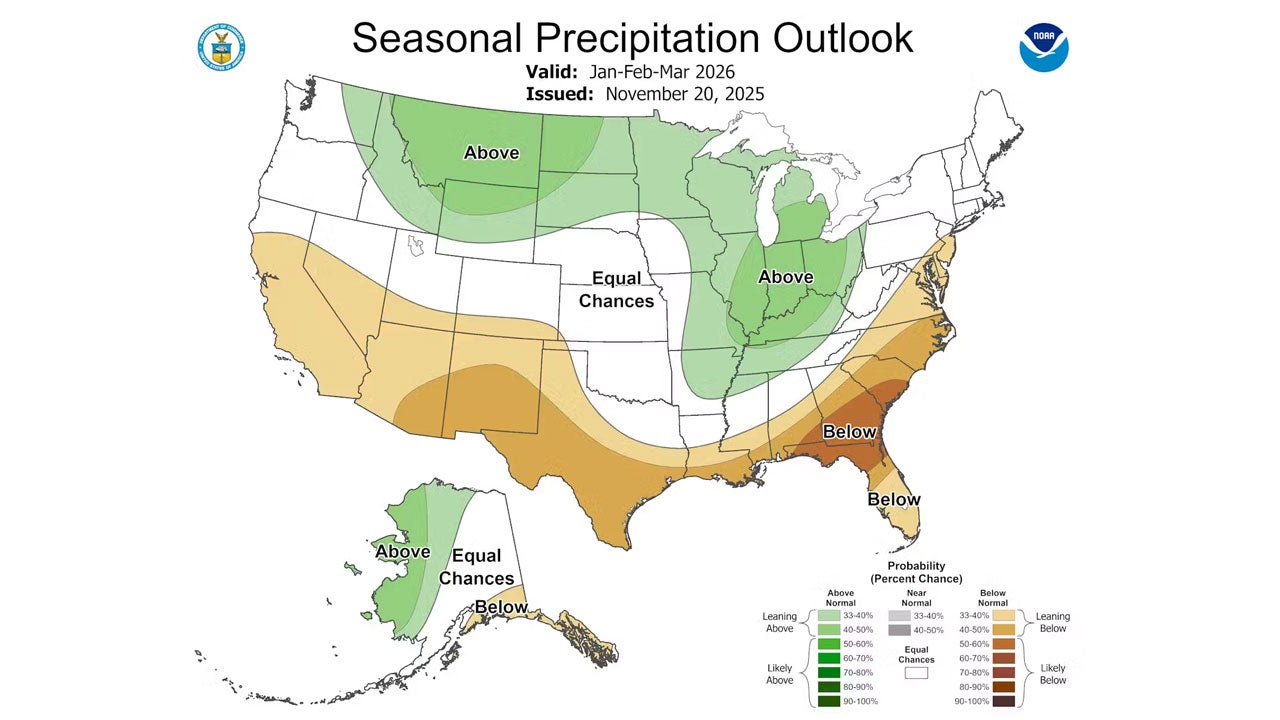
If you look atNOAA's seasonal outlook maps, most of Colorado and Utah are in the gap between the cooler and wetter pattern to the north and the warmer and drier pattern to the south expected during winter 2026. So, the outlook suggests roughly equal chances of more or less snow than normal and warmer or cooler weather across many major ski areas.

How is climate change affecting snowfall in the West?

In the West, snow measurements date back a century, so we can see some trends.

Starting in the 1920s, surveyors would go out into the mountains andmeasure the snowpackin March and April every year. Those records suggestsnowfall has declinedin most of the West. We also see evidence ofmore midwinter melting.

How much snow falls is driven by both temperature and precipitation, andtemperature is warming.

Chart: The Conversation, CC-BY-ND, Source: NOAA

In the past few years, research has been able todirectly attribute observed changesin the spring snowpack to human-caused climate change. Rising temperatures have led to decreases in snow, particularly in the Southwest. The effects of warming temperatures on overall precipitation are less clear, but the net effect in the western U.S. is a decrease in the spring snowpack.

When we look atclimate change projections for the western U.S.in future years, we see with a high degree of confidence that we canexpect less snow in warmer climates. In scenarios where the world produces more greenhouse gas emissions, that'sworse for snow seasons.

Should states be worried about water supplies?

This winter's forecast isn't extreme at this point, so the impact on the year's water supplies is a pretty big question mark.

Snowpack – how much snow is on the ground in March or April –sums up the snowfall, minus the melt, for the year. The snowpack also affects water supplies for the rest of the year.

TheWest's water infrastructure systemwas built assuming there would be a natural reservoir of snow in the mountains. California relies on the snowpack forabout a thirdof its annual water supply.

However, rising temperatures are leading toearlier snowmelt in some areas. Evidence suggests that climate change is also expected to causemore rain-on-snow eventsat high elevations, which can cause very rapid snowmelt.

Luis Sinco/Los Angeles Times via Getty Images

Both create challenges for water managers, who want to store as much snowmelt runoff as possible in reservoirs so it's available through the summer, when states need it most for agriculture and for generating hydropower to meet high electricity demand. If the snow melts early, water resource managers face some tough decisions, because they also need to leave room in their reservoirs to manage flooding. Earlier snowmelt sometimes means they have to release stored water.

When we look at reservoir levels in the Colorado River basin, particularly the big reservoirs – Lake Powell and Lake Mead – we see apattern of decline over time. They have had some very good snow and water years, and also particularly challenging ones, including along-running drought. The long-term trends suggest an imbalance between supply andgrowing demand.

Chart: The Conversation, CC-BY-ND, Source: U.S. Bureau of Reclamation

What else does snowfall affect, such as fire risk?

During low-snow years, the snowpack disappears sooner, and thesoils dry out earlierin the year. That essentially leaves a longer summer dry period andmore stress on trees.

There is evidence that we tend to havebigger fire seasons after low-snow winters. That can be because the forests are left with drier fuels, which sets the ecosystem up to burn. That's obviously a major concern in the West.

Snow is also important to a lot of wildlife species that are adapted to it. Oneexample is the wolverine, an endangered species that requires deep snow for denning over the winter.

What snow lessons should people take away from climate projections?

Overall, climate projections suggest our biggest snow years will beless snowy in anticipated warmer climates, and thatvery low snow yearsare expected to be more common.

But it's important to remember that climate projections arebased on scenariosof how much greenhouse gas might be emitted in the future – they are not predictions of the future. The worldcan still reduce its emissionstocreate a less risky scenario. In fact, while the most ambitious emissions reductions are looking less likely, theworst emissions scenarios are also less likelyunder current policies.

Understanding how choices can change climate projections can be empowering.Projections are saying: Here's what we expect to happen if the world emits a lot of greenhouse gases, and here's what we expect to happen if we emit fewer greenhouse gases based on recent trends.

The choices we make will affect our future snow seasons and the wider climate.

This article has been updated to correct the references to Denver, which saw one of its latest snowfalls on record.

Adrienne Marshall, Assistant Professor of Geology and Geological Engineering, Colorado School of Mines

Winter storms blanket the East, while the US West is wondering: Where’s the snow?

Ski season is here, but while the eastern half of the U.S.digs out from wintery storms, the western U.S. snow season has ...
Debris is piled up at the entrance to Camp Mystic on July 7, 2025 in Hunt, Texas. (Brandon Bell / Getty Images file)

Camp Mystic has announced its plan to reopen next summer with new safety measures aftermore than two dozen people were killed in floodsat the all-girls Texas summer camp earlier this year.

Twenty-seven children and camp counselors died after slow-moving thunderstorms in Kerr County caused the Guadalupe River to flood.

In a message to parents issued Tuesday, the camp said it is preparing for next summer's event at their newer Cypress Lake location, which is "completely independent from the older Guadalupe River camp, with a separate entrance, waterfront, dining hall, office, pavilion, infirmary, playing fields, archery range, stables, chapel, and cabins," according to their website.

The camp said it has taken steps to enhance security at the location, including installing over 100 flood monitoring units along Cypress Lake and the South and North forks of the Guadalupe River.

"The system will provide early detection of high-water events, as it communicates for miles with other sensors using LoRaWAN (low-range wide-area network) technology, allowing campers, counselors and staff to respond and quickly and safely evacuate to an elevated muster station," the camp said.

An officer prays with a family as they pick up items at Camp Mystic in Hunt, Texas on Wednesday, July 9, 2025.  (Ashley Landis / AP)

Hand-held two-way radios with weather alerts from the National Oceanic and Atmospheric Administration will be added to each cabin, and the camp's internet will be backed up with satellite internet, the camp said. The campdoes not allow attendees to have their phones, and cell service at the Guadalupe camp earlier this year was reportedly spotty.

The camp will also add "higher-capacity generators to maintain power in critical areas," like the office and dining hall.

"These enhancements will also help us maintain communication with emergency personnel and parents in the event of an emergency," the camp said in the message.

The 2026 camp dates start on May 30 and end on Aug. 9, designating 10-day stints for girls of different ages, the camp said. Enrollment has not yet opened.

On the morning of July 4, the Guadalupe River in Kerr Countyoverflowed as a result of consistent rainfall, putting Camp Mystic attendees asleep in their cabins at risk.

"We recognize that returning to Camp Mystic carries both hope and heartache," the camp acknowledged in the message to parents. "For many of your daughters, this return is not simple, but it is a courageous step in their healing journey."

The camp is also offering tours of the Cypress Lake location in April where families can ask questions.

Camp Mystic to open with new safety plan after 27 kids and counselors died in Texas floods

Camp Mystic has announced its plan to reopen next summer with new safety measures aftermore than two dozen people were killed in floodsat t...
Texas' Steve Sarkisian questions why team bothered to play Ohio State

Texas coach Steve Sarkisian is questioning why his team played defending champion Ohio State this season with it looking possible his squad will miss the College Football Playoff field.

The No. 16 Longhorns (9-3) upset then-No. 3 Texas A&M on Friday to keep their hopes alive. But losses to then-No. 3 Ohio State, unranked Florida and then-No. 5 Georgia are a problem with several teams with fewer losses also in contention for at-large berths.

"Why did we even play Ohio State?" Sarkisian said on SiriusXM on Tuesday of the 14-7 loss. "Because if we're a 10-2 team right now that played four top-10 ranked opponents with three top-10 wins, we're not even having a discussion right now. So, my point is: Why the hell am I going to play that game next year? For what? What good does it do?"

The Buckeyes and Longhorns are slated to meet in 2026 in Austin, so perhaps next time Texas notches a big victory and isn't in a similar position.

Then again, Sarkisian says the CFP guidelines make it feel like there is no need to play a team like Ohio State.

"I'm looking at the principles of the CFP," Sarkisian said. "I'm looking at the sheet of paper right now. The first two bullet points say strength of schedule and head-to-head competition. That's the frustrating part. So, to me, when you talk about future scheduling -- and we don't get in? -- what's the point in playing them. There's no benefit to that.

"And we're going to nine games in the SEC next year. I get it, there's going to be a network (ESPN) upset if we don't play that game, because there's probably going to be 15 to 16 million viewers that would watch that game. But I get no benefit from playing the game. It does nothing for me. I have a responsibility to the University of Texas and our players to put them in the best position."

Prior to Tuesday night's reveal of the latest CFP rankings ahead of championship weekend, Texas has head-to-head victories over three Southeastern Conference programs ranked in the top 10 at the time in which the teams played -- No. 6 Oklahoma, No. 9 Vanderbilt and No. 3 Texas A&M. The Longhorns lost to No. 5 Georgia and didn't face Ole Miss or Alabama.

The big blow is the 29-21 loss to Florida on Oct. 4, a team that fired coach Billy Napier 15 days later.

No. 12 Miami of the Atlantic Coast Conference is one of the other teams facing the same uphill climb as the Longhorns. And the two coaches exchanged barbs on Monday.

Sarkisian criticized Miami coach Mario Cristobal on Monday for the Hurricanes scoring a touchdown with 41 seconds left to pad the victory margin in Miami's 38-7 win over Pitt on Saturday.

"There's teams that are ranked in front of us that haven't played any top-10 ranked teams," Sarkisian said on SEC Network. "My point to everybody is, is this about what your record is at the end? Or is this about beating quality teams and showing how good of a team you really are by beating quality teams on the field. Or is it don't play good teams, put up a bunch of yards, put up a bunch of points and make it look good. Throw fade route touchdowns with 38 seconds to go when you're ahead 31-7 so that the score looks better.

"Is the committee watching the games or are they looking at a stat sheet at the end of the game to say, 'Oh, well they won by this many points, they must've played really good.'"

Cristobal was only too happy to return serve and use Florida (4-8) as an example, a common opponent of both teams. The Hurricanes beat the Gators 26-7.

"I get it, everybody's trying to posture themselves for their programs and whatnot. The great part about stuff like that when coaches try to speak about themselves like that, they also gotta take a look at the common opponent between us and that particular coach," Cristobal said on Canes In Sight. "Seeing that we had the opportunity to really dominate that opponent while that opponent dominated them."

Miami played one top-10 team, beating Notre Dame 27-24 in its season opener.

--Field Level Media

Texas' Steve Sarkisian questions why team bothered to play Ohio State

Texas coach Steve Sarkisian is questioning why his team played defending champion Ohio State this season with it looking ...
Sarah Strong scores 14 to lead No. 1 UConn over South Florida 85-51

TAMPA, Fla. (AP) — Sarah Strong had 14 points and 10 rebounds to lead the No. 1 UConn Huskies to an 85-51 win over South Florida on Tuesday.

Blanca Quinonez added 13 points including three 3-pointers for the defending national champions. Azzi Fudd and Ashlynn Shade each scored 10 points. UConn shot 51% (32 for 63) from the floor.

UConn (8-0) scored the first 10 points of the game and took a 29-10 lead after the first period. The Huskies led 48-16 at halftime.

L'or Mputu had 12 points and seven rebounds to lead South Florida (5-4). Carla Brito had eight points and seven rebounds. The Bulls had 20 turnovers.

The Huskies went on a 15-2 run to end the first period and pushed their lead to 42-12 midway through the second period. UConn led by as many as 38 in the second half.

UConn is 143-0 all-time against American Conference opponents.

UConn: Hosts Depaul on Sunday.

South Florida: Hosts Houston Christian on Friday.

Get poll alerts and updates on the AP Top 25 throughout the season. Sign uphereandhere(AP mobile app). AP women's college basketball:https://apnews.com/hub/ap-top-25-womens-college-basketball-pollandhttps://apnews.com/hub/womens-college-basketball

Sarah Strong scores 14 to lead No. 1 UConn over South Florida 85-51

TAMPA, Fla. (AP) — Sarah Strong had 14 points and 10 rebounds to lead the No. 1 UConn Huskies to an 85-51 win over South ...


COSMO MAG © 2015 | Distributed By My Blogger Themes | Designed By Templateism.com